




 Ethiopia
 Azerbaijan
 Türkiye
 Uzbekistan
 Kazakhstan
 Turkmenistan
 Kyrgyzstan
 Republic of Korea
 Japan
 India
 United States of America
 Kosovo
STRUCTURAL PATTERNS OF HYPHENATED COMPOUND NOUNS IN MODERN ENGLISH
- Authors
-
-
Nargiza Yuldasheva
Uzbekistan state world languages university, Tashkent, Uzbekistan
Author
-
- Keywords:
- Array
- Abstract
-
This study investigates the structural patterns of hyphenated compound nouns in Modern English, focusing on their morphological formation, syntactic behavior, and functional distribution in contemporary written discourse. Hyphenated compounds represent a productive lexical strategy in English word formation, contributing to clarity, specificity, and semantic cohesion. The research is based on a corpus-driven approach, analyzing data collected from academic articles, news texts, and digital communication sources. The study identifies major structural models of hyphenated compounds, including noun-noun, adjective-noun, participial, and multi-element constructions. The findings reveal that hyphenation plays a significant role in lexical innovation and meaning compression in Modern English. The study also highlights the increasing productivity of hyphenated compounds in digital and academic genres. The results contribute to a better understanding of compound noun formation processes and their role in contemporary English morphology.
- Downloads
-
Download data is not yet available.
- References
-
1.Bauer, L. (2001). Morphological Productivity. Cambridge University Press.
2.Plag, I. (2003). Word-Formation in English. Cambridge University Press.
3.Lieber, R. (2009). Introducing Morphology. Cambridge University Press.
4.Marchand, H. (1969). The Categories and Types of Present-Day English Word-Formation.
5.Quirk, R. et al. (1985). A Comprehensive Grammar of the English Language. Longman.
6.Ergashbayevna, Y. N. (2025). The Role Of Compound Nouns In English And Uzbek Languages In Culture And Linguistics.
7.Ergashbayevna, Y. N. (2026). Morphological And Semantic Functions Of Compound Nouns In The Process Of Naming.
- Cover Image
-
- Downloads
- Published
- 2026-06-11
- Section
- Articles
- License
-

This work is licensed under a Creative Commons Attribution 4.0 International License.
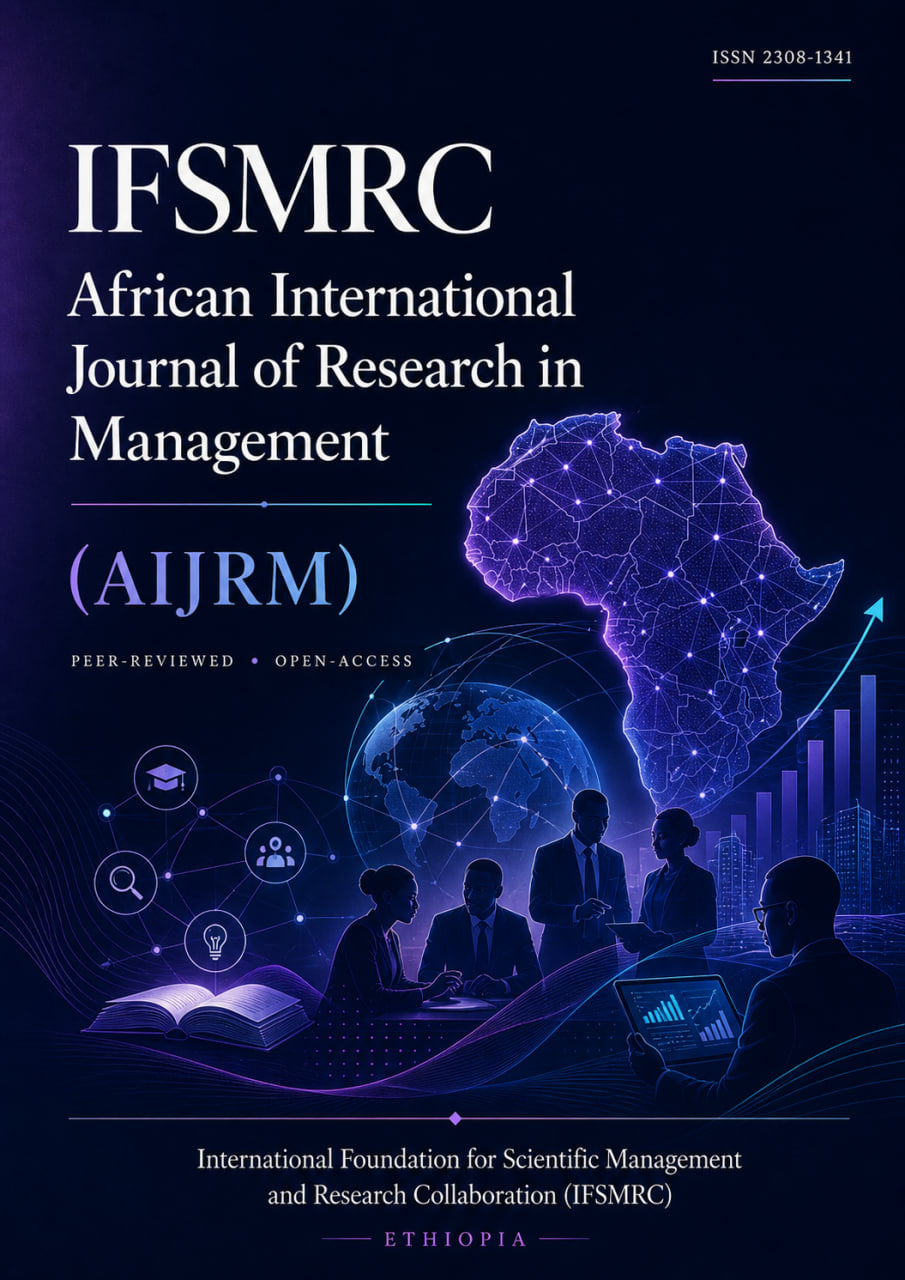
All articles published in the IFSMRC African International Journal of Research in Management (AIJRM) are licensed under the Creative Commons Attribution 4.0 International License (CC BY 4.0). Authors retain full copyright of their work without restriction. By publishing in AIJRM, authors grant the journal the right to publish and distribute the article as the original publisher. This license permits users to read, download, copy, share, and adapt the work for lawful purposes with proper attribution to the author(s) and the journal. All reuse must appropriately acknowledge the original source of publication.

How to Cite
Similar Articles
- Mullajanova Zukhroyulduz Alimjanovna, MORPHOLOGICAL, SEMANTIC AND PRAGMATIC FEATURES OF COMPOUND ANTHROPONYMS IN ENGLISH , IFSMRC African International Journal of Research in Management: Vol. 14 No. 06 (2026): IFSMRC African International Journal of Research in Management (AIJRM)
- Nurullayeva Oydin Nazirjon qizi, CRITERIA FOR DETERMINING TRANSLATION EQUIVALENCE OF STABLE COMBINATIONS IN THE UZBEK–ENGLISH PARALLEL CORPUS , IFSMRC African International Journal of Research in Management: Vol. 14 No. 06 (2026): IFSMRC African International Journal of Research in Management (AIJRM)
- Ismailova Raime Setiyayevna, Baymirzayeva M.R., HOMONIMS IN ENGLISH AND THEIR SPECIFIC FEATURES , IFSMRC African International Journal of Research in Management: Vol. 14 No. 06 (2026): IFSMRC African International Journal of Research in Management (AIJRM)
- Mokhinur Murodova Azamat qizi,Risolat Achilova, MORPHOLOGICAL STRUCTURE OF THE MOST ACTIVE ABBREVIATED UNITS IN GAMING CHATS , IFSMRC African International Journal of Research in Management: Vol. 14 No. 05 (2026): IFSMRC African International Journal of Research in Management (AIJRM)
- Oyshakhon Muhammadhaniyevna Majitova, Farangis Nasriddinova, A CORPUS-BASED STYLISTIC ANALYSIS OF EVALUATIVE LANGUAGE IN CONTEMPORARY ENGLISH MEDIA DISCOURSE: IDEOLOGICAL FRAMING, EMOTIONAL ENGAGEMENT, AND DIGITAL JOURNALISM , IFSMRC African International Journal of Research in Management: Vol. 14 No. 06 (2026): IFSMRC African International Journal of Research in Management (AIJRM)
- Giyasova Azizakhan Muratovna, MODERN SCIENTIFIC APPROACHES TO TEACHING ENGLISH PROFESSIONALLY IN THE TRAINING OF JOURNALISTS: A REVIEW AND SYNTHESIS , IFSMRC African International Journal of Research in Management: Vol. 14 No. 06 (2026): IFSMRC African International Journal of Research in Management (AIJRM)
- Asqar Abdullayev, COMMUNICATIVE FEATURES OF THE SIMPLE SENTENCE IN MODERN ENGLISH AND UZBEK LANGUAGES , IFSMRC African International Journal of Research in Management: Vol. 14 No. 06 (2026): IFSMRC African International Journal of Research in Management (AIJRM)
- T. S. Eshboyeva, Azamatova Shaxzoda, LINGUOPOETIC ANALYSIS AS A SCIENTIFIC METHOD IN LINGUISTICS , IFSMRC African International Journal of Research in Management: Vol. 14 No. 05 (2026): IFSMRC African International Journal of Research in Management (AIJRM)
- Umida Abduqahhorovna Azimova, EXPRESSION OF DIMINUTIVE-AFFECTIVE MEANINGS AT DIFFERENT LEVELS IN UZBEK AND RUSSIAN LANGUAGES , IFSMRC African International Journal of Research in Management: Vol. 14 No. 05 (2026): IFSMRC African International Journal of Research in Management (AIJRM)
- Salimova Sabina Khamidjon kizi, STRUCTURAL FEATURES OF PHRASEOLOGICAL UNITS WITH THE COMPONENT “눈” IN KOREAN AND UZBEK , IFSMRC African International Journal of Research in Management: Vol. 14 No. 06 (2026): IFSMRC African International Journal of Research in Management (AIJRM)
You may also start an advanced similarity search for this article.