




 Ethiopia
 Azerbaijan
 Türkiye
 Uzbekistan
 Kazakhstan
 Turkmenistan
 Kyrgyzstan
 Republic of Korea
 Japan
 India
 United States of America
 Kosovo
ETHNOCULTURAL CODES OF THE ENGLISH AND UZBEK LINGUISTIC WORLDVIEWS
- Authors
-
-
G. R. Aminova
Uzbekistan State World Languages University
Author
-
- Keywords:
- Array
- Abstract
-
This article examines language as a means of representing ethnocultural meanings based on the material of the English and Uzbek languages. The main focus is placed not on external cultural realia, but on internal linguistic units through which national worldview, value systems, social hierarchy, communicative distance, and moral evaluation are expressed. The analysis of Uzbek concepts such as andisha, hayo, oriyat, oqibat, ko‘ngil, yuz, gap-so‘z, egachi, quda, ovsin, boja, fotiha, rozi-rizolik and English concepts such as privacy, personal boundaries, understatement, self-reliance, and fair play reveals specific features of the ethnocultural consciousness of the two peoples. The theoretical basis of the research is formed by the works of Russian and Uzbek linguists in the fields of linguoculturology, ethnolinguistics, cognitive linguistics, and intercultural communication. The article concludes that language not only reflects culture but also fixes ways of social evaluation, speech behavior, and interpretation of human relations.
- Downloads
-
Download data is not yet available.
- References
-
1.Arutyunova, N. D. (1999). Language and the World of Man. Moscow: Languages of Russian Culture.
2.Ashurova, D. U., & Galieva, M. R. (2016). Stylistics of Literary Text. Tashkent: Turon-Iqbol.
3.Karasik, V. I. (2002). Language Circle: Personality, Concepts, Discourse. Volgograd: Peremena.
4.Mahmudov, N. M. (1998). Til. Tashkent: Yozuvchi.
5.Maslova, V. A. (2001). Linguoculturology: A Textbook for Students of Higher Educational Institutions. Moscow: Akademiya.
6.Nurmonov, A. (2002). History of Uzbek Linguistics: A Textbook for Students of Uzbek Philology Faculties. Tashkent: O‘zbekiston.
7.Safarov, Sh. (2006). Cognitive Linguistics. Jizzakh: Sangzor.
8.Safarov, Sh., & Toirova, G. (2007). Foundations of Ethnosociopragmatic Analysis of Speech. Samarkand: SamSIFL.
9.Stepanov, Yu. S. (2004). Constants: A Dictionary of Russian Culture. Moscow: Akademicheskiy Proekt.
10.Teliya, V. N. (1996). Russian Phraseology: Semantic, Pragmatic and Linguocultural Aspects. Moscow: School “Languages of Russian Culture”.
11.Ter-Minasova, S. G. (2000). Language and Intercultural Communication. Moscow: Slovo.
12.Vorobyev, V. V. (1997). Linguoculturology: Theory and Methods. Moscow: Peoples’ Friendship University of Russia.
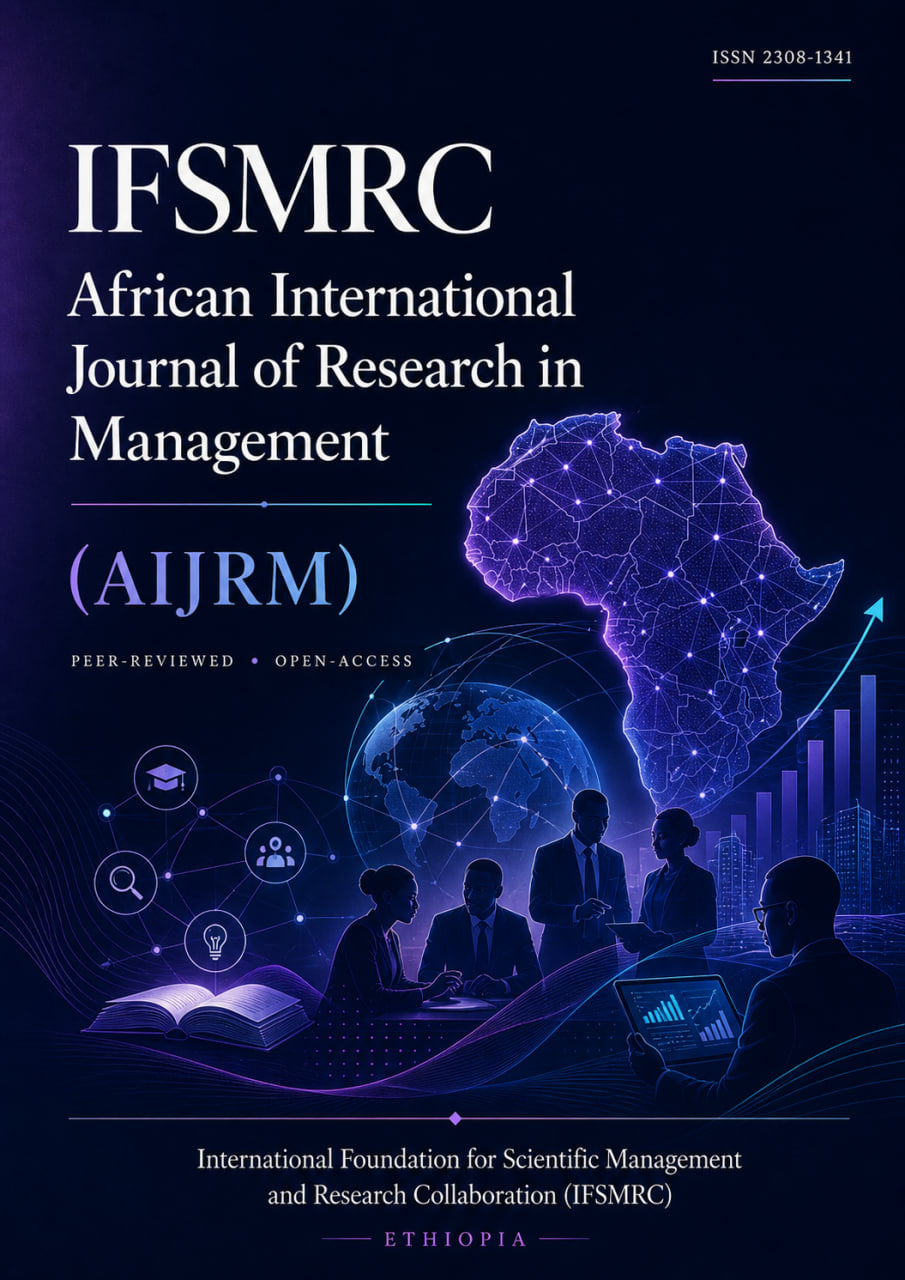
- Cover Image
-
- Downloads
- Published
- 2026-06-13
- Section
- Articles
- License
-

This work is licensed under a Creative Commons Attribution 4.0 International License.
All articles published in the IFSMRC African International Journal of Research in Management (AIJRM) are licensed under the Creative Commons Attribution 4.0 International License (CC BY 4.0). Authors retain full copyright of their work without restriction. By publishing in AIJRM, authors grant the journal the right to publish and distribute the article as the original publisher. This license permits users to read, download, copy, share, and adapt the work for lawful purposes with proper attribution to the author(s) and the journal. All reuse must appropriately acknowledge the original source of publication.

How to Cite
Similar Articles
- Ziyayev Avazjon Ixtiyorovich, COGNITIVE-PRAGMATIC AND LINGUOCULTURAL FEATURES OF PARALINGUISTIC MEANS IN ENGLISH AND UZBEK LANGUAGES , IFSMRC African International Journal of Research in Management: Vol. 14 No. 06 (2026): IFSMRC African International Journal of Research in Management (AIJRM)
- Shohsanam Bekmuratova, A LINGUOCULTURAL ANALYSIS OF PATRIOTISM IN UZBEK PROVERBS AND THEIR ENGLISH TRANSLATION , IFSMRC African International Journal of Research in Management: Vol. 14 No. 05 (2026): IFSMRC African International Journal of Research in Management (AIJRM)
- Sa’dullayeva Ozoda Zoid Qizi, SEMANTIC ANALYSIS OF THE CONCEPT OF ENVY IN KOREAN AND UZBEKISTAN ARTICLES BASED ON DIGITAL CORPUS AND ONLINE PLATFORMS , IFSMRC African International Journal of Research in Management: Vol. 14 No. 06 (2026): IFSMRC African International Journal of Research in Management (AIJRM)
- Mullajanova Zukhroyulduz Alimjanovna, COMPOUND ANTHROPONYMS AS CULTURALLY MARKED SIGNS: LINGUOCULTURAL AND SEMIOTIC PERSPECTIVES , IFSMRC African International Journal of Research in Management: Vol. 14 No. 06 (2026): IFSMRC African International Journal of Research in Management (AIJRM)
- Mekhruza Normurodova, COMPARATIVE LINGUOCULTURAL ANALYSIS OF PROVERBS EXPRESSING HUMAN CHARACTER IN ENGLISH AND UZBEK , IFSMRC African International Journal of Research in Management: Vol. 14 No. 06 (2026): IFSMRC African International Journal of Research in Management (AIJRM)
- M.K. Juraeva, Theoretical and Practical Significance of the Linguistic Analysis of the Phenomenon of “Courage” in the Semantic Field of “Spirituality” , IFSMRC African International Journal of Research in Management: Vol. 14 No. 05 (2026): IFSMRC African International Journal of Research in Management (AIJRM)
- Azimova Nigora Akhmad kizi, TEACHING KONGLISH VOCABULARY IN KOREAN LANGUAGE EDUCATION: LINGUISTIC CHARACTERISTICS AND PEDAGOGICAL IMPLICATIONS FOR UZBEK LEARNERS , IFSMRC African International Journal of Research in Management: Vol. 14 No. 06 (2026): IFSMRC African International Journal of Research in Management (AIJRM)
- Indira Khodjalepesova, LINGUODIDACTIC SIGNIFICANCE OF USING PAREMIOLOGICAL UNITS IN TEACHING ENGLISH , IFSMRC African International Journal of Research in Management: Vol. 14 No. 05 (2026): IFSMRC African International Journal of Research in Management (AIJRM)
- Munisa Bahrombekova,Shirin Khamrabaeva, LINGUISTIC EXPRESSION OF GENDER IMAGES IN ENGLISH AND UZBEK LANGUAGES (BASED ON THE TRANSLATIONS OF JANE AUSTEN’S PRIDE AND PREJUDICE) , IFSMRC African International Journal of Research in Management: Vol. 14 No. 05 (2026): IFSMRC African International Journal of Research in Management (AIJRM)
- Murodkhodzhaeva Malika Alisherovna, SEMANTIC VACUUMS AND TRANSLATION SPECIFICITY OF NON-EQUIVALENT LEXICON (BASED ON RUSSIAN, UZBEK, AND ENGLISH) , IFSMRC African International Journal of Research in Management: Vol. 14 No. 06 (2026): IFSMRC African International Journal of Research in Management (AIJRM)
You may also start an advanced similarity search for this article.