




 Ethiopia
 Azerbaijan
 Türkiye
 Uzbekistan
 Kazakhstan
 Turkmenistan
 Kyrgyzstan
 Republic of Korea
 Japan
 India
 United States of America
 Kosovo
COMPARATIVE ANALYSIS OF MATHEMATICAL TERMS USED IN UZBEK AND ENGLISH FOLK RIDDLES
- Authors
-
-
Nuridinova Dilinura Khamzayevna
Teacher, Department of English Philology, Fergana State University
Author
-
- Keywords:
- Array
- Abstract
-
This article presents a comparative linguistic and cognitive analysis of mathematical terms and lexical units with mathematical semantics used in Uzbek and English folk riddles. The study examines the functions of numerals, counting forms, quantity expressions, geometric shapes, measurements, proportions, and spatial relations as clues, comparative markers, figurative devices, and didactic tools in riddle texts. The analysis identifies both similarities and differences in the use of mathematical terminology in Uzbek and English folk riddles. The findings demonstrate that mathematical units in both traditions play a significant role in describing hidden objects, stimulating logical thinking, and developing children's cognitive abilities. However, Uzbek folk riddles tend to associate numbers with folk imagery, kinship metaphors, nature, and household objects, whereas English riddles more frequently employ mathematical units through logical questions, object shapes, functions, and practical characteristics.
- Downloads
-
Download data is not yet available.
- References
-
1.Husainova Z. O‘zbek topishmoqlari. – Toshkent: Fan, 1966.
2.Topishmoqlar. O‘zbek xalq ijodi. Ko‘p tomlik. – Toshkent: G‘afur G‘ulom nomidagi Adabiyot va san’at nashriyoti, 1983.
3.Qosimova K., Matchonov S., G‘ulomova X., Yo‘ldosheva Sh., Sariyev Sh. Ona tili o‘qitish metodikasi. – Toshkent: Noshir, 2009.
4.Jarov V.K., Turgunbayev R.M. Matematik atamalarning o‘quv leksik minimumi. – Toshkent: Innovatsiya-Ziyo, 2020.
5.Ruzmetova O.A. O‘zbek tilida matematik terminlar yasalishining morfologik usuli // O‘zbekistonda xorijiy tillar. – 2022.
6.Jo‘rayev M., Eshonqulov G‘. Folklorshunoslikka kirish. – Toshkent: Turon-Iqbol, 2018.
7.Imomov K., Mirzayev T., Sarimsoqov B., Safarov O. O‘zbek xalq og‘zaki poetik ijodi. – Toshkent: O‘qituvchi, 1990.
8.Taylor A. English Riddles from Oral Tradition. – Berkeley: University of California Press, 1951.
9.Mieder W. Proverbs: A Handbook. – Greenwood Press, 2004.
10.Crystal D. The Cambridge Encyclopedia of the English Language. – Cambridge University Press, 2003.
11.Lakoff G. Women, Fire, and Dangerous Things. – Chicago: University of Chicago Press, 1987.
12.Langacker R. Cognitive Grammar: A Basic Introduction. – Oxford University Press, 2008.
13.Wierzbicka A. Understanding Cultures Through Their Key Words. – Oxford University Press, 1997.
14.Oxford Dictionary of English Folklore. – Oxford University Press, 2000.
15.The Oxford Dictionary of Proverbs. – Oxford University Press, 2015.
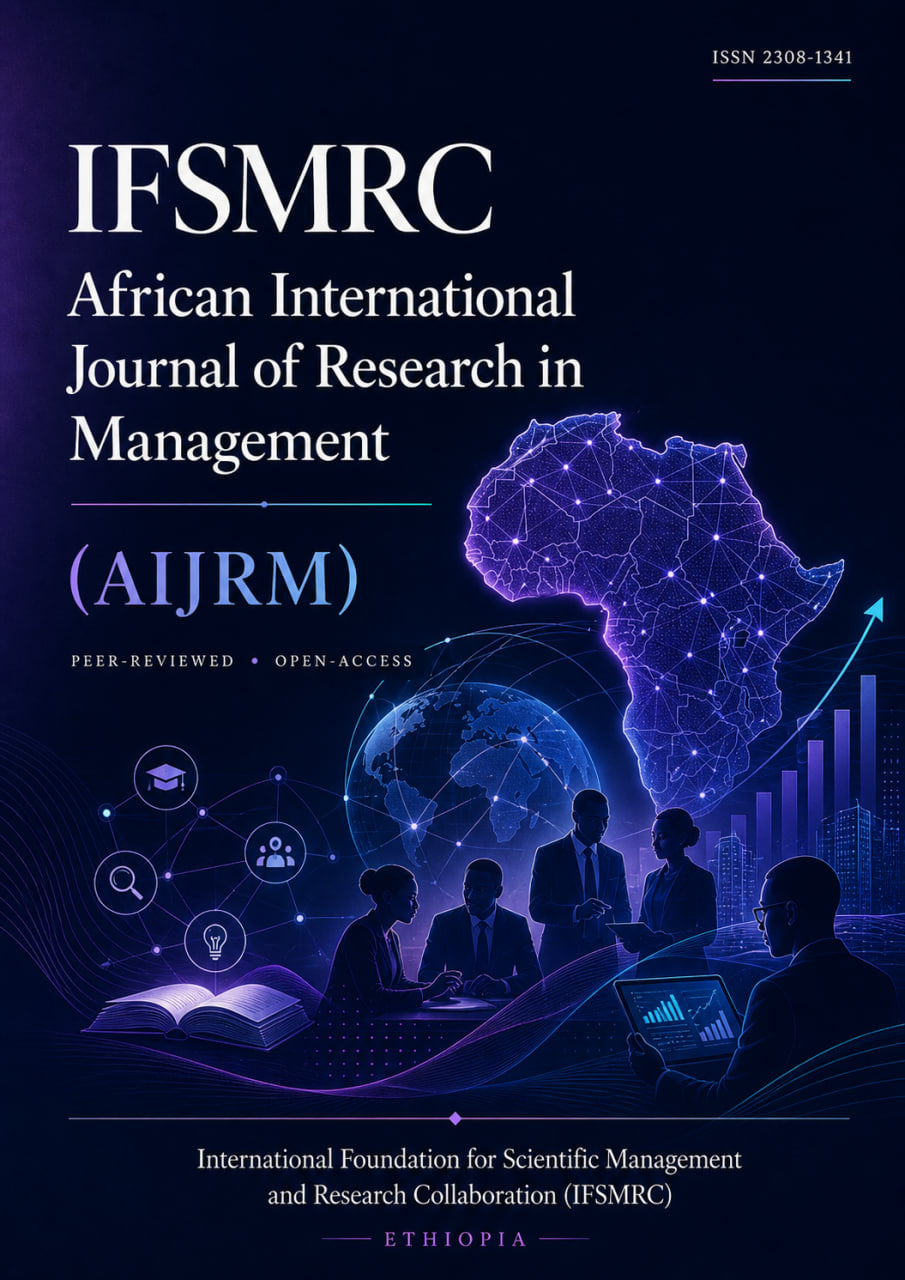
- Cover Image
-
- Downloads
- Published
- 2026-06-06
- Section
- Articles
- License
-

This work is licensed under a Creative Commons Attribution 4.0 International License.
All articles published in the IFSMRC African International Journal of Research in Management (AIJRM) are licensed under the Creative Commons Attribution 4.0 International License (CC BY 4.0). Authors retain full copyright of their work without restriction. By publishing in AIJRM, authors grant the journal the right to publish and distribute the article as the original publisher. This license permits users to read, download, copy, share, and adapt the work for lawful purposes with proper attribution to the author(s) and the journal. All reuse must appropriately acknowledge the original source of publication.

How to Cite
Similar Articles
- M.K. Juraeva, Theoretical and Practical Significance of the Linguistic Analysis of the Phenomenon of “Courage” in the Semantic Field of “Spirituality” , IFSMRC African International Journal of Research in Management: Vol. 14 No. 05 (2026): IFSMRC African International Journal of Research in Management (AIJRM)
- Ziyayev Avazjon Ixtiyorovich, COGNITIVE-PRAGMATIC AND LINGUOCULTURAL FEATURES OF PARALINGUISTIC MEANS IN ENGLISH AND UZBEK LANGUAGES , IFSMRC African International Journal of Research in Management: Vol. 14 No. 06 (2026): IFSMRC African International Journal of Research in Management (AIJRM)
- Sa’dullayeva Ozoda Zoid Qizi, SEMANTIC ANALYSIS OF THE CONCEPT OF ENVY IN KOREAN AND UZBEKISTAN ARTICLES BASED ON DIGITAL CORPUS AND ONLINE PLATFORMS , IFSMRC African International Journal of Research in Management: Vol. 14 No. 06 (2026): IFSMRC African International Journal of Research in Management (AIJRM)
- G. R. Aminova, ETHNOCULTURAL CODES OF THE ENGLISH AND UZBEK LINGUISTIC WORLDVIEWS , IFSMRC African International Journal of Research in Management: Vol. 14 No. 06 (2026): IFSMRC African International Journal of Research in Management (AIJRM)
- Mekhruza Normurodova, COMPARATIVE LINGUOCULTURAL ANALYSIS OF PROVERBS EXPRESSING HUMAN CHARACTER IN ENGLISH AND UZBEK , IFSMRC African International Journal of Research in Management: Vol. 14 No. 06 (2026): IFSMRC African International Journal of Research in Management (AIJRM)
- Asqar Abdullayev, COMMUNICATIVE FEATURES OF THE SIMPLE SENTENCE IN MODERN ENGLISH AND UZBEK LANGUAGES , IFSMRC African International Journal of Research in Management: Vol. 14 No. 06 (2026): IFSMRC African International Journal of Research in Management (AIJRM)
- Mustafoyeva Maksad Askarovna, COMPARATIVE STUDY OF ANTHROPONYMS IN THE UZBEK AND ENGLISH FOLK EPICS , IFSMRC African International Journal of Research in Management: Vol. 14 No. 05 (2026): IFSMRC African International Journal of Research in Management (AIJRM)
- Ayubova Saida Musadjanovna, ENHANCING CONTENT AND LANGUAGE INTEGRATED LEARNING (CLIL) THROUGH THE PEDAGOGICAL POTENTIAL OF ENGLISH LANGUAGE TEACHING: A CONCEPTUAL FRAMEWORK FOR EDUCATION SYSTEMS , IFSMRC African International Journal of Research in Management: Vol. 14 No. 05 (2026): IFSMRC African International Journal of Research in Management (AIJRM)
- Shohsanam Bekmuratova, A LINGUOCULTURAL ANALYSIS OF PATRIOTISM IN UZBEK PROVERBS AND THEIR ENGLISH TRANSLATION , IFSMRC African International Journal of Research in Management: Vol. 14 No. 05 (2026): IFSMRC African International Journal of Research in Management (AIJRM)
- Oyshakhon Muhammadhaniyevna Majitova, Farangis Nasriddinova, A CORPUS-BASED STYLISTIC ANALYSIS OF EVALUATIVE LANGUAGE IN CONTEMPORARY ENGLISH MEDIA DISCOURSE: IDEOLOGICAL FRAMING, EMOTIONAL ENGAGEMENT, AND DIGITAL JOURNALISM , IFSMRC African International Journal of Research in Management: Vol. 14 No. 06 (2026): IFSMRC African International Journal of Research in Management (AIJRM)
You may also start an advanced similarity search for this article.